Designing a clean and climate-friendly electricity grid for California’s disadvantaged communities
California must rapidly cut carbon emissions from the energy sector while maintaining a reliable electricity system. Distributed energy resources—such as rooftop solar, battery storage, and electrified technologies—will play a key role in this transition. However, adoption has been uneven, and without thoughtful policy and planning, disadvantaged communities risk being left with higher energy costs and continued exposure to polluting technologies.
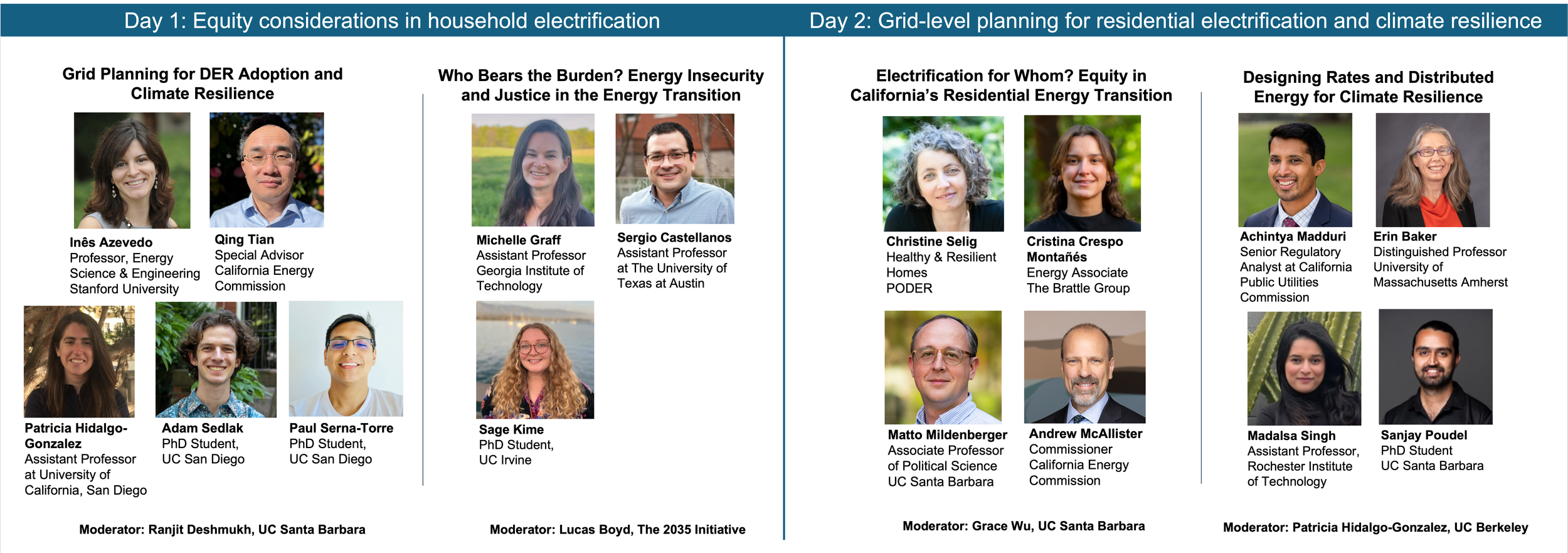
Researchers at UC Berkeley, UC San Diego, and UC Santa Barbara hosted a virtual Energy Justice Workshop on Residential Electrification, Distributed Energy Resources (DERs), and Grid Planning for Climate Resilience. The workshop brought together researchers, policymakers, planning agencies, NGOs, and other energy stakeholders to discuss how California can design a clean, resilient, and equitable electricity system as residential electrification accelerates. The panels featured speakers from the California Energy Commission, California Public Utilities Commission, community organizations like PODER, universities (UCs, Stanford, UMass), and more. It was organized around two main themes: Equity considerations in household electrification and Grid-level planning for residential electrification and climate resilience.
Principal Investigators: Patricia Hidalgo-Gonzalez, Ranjit Deshmukh, Grace Wu, Matto Mildenberger, Michael Ludkovski, Duncan Callaway, Jan Kleissl