
Polling Memo
Methodology for a large, representative survey of planned and prospective large-scale solar development
Gabriel De Roche, Ph.D.
Director of Polling and Survey Research
May 29, 2026
In partnership with the Solar and Storage Industries Institute (SI2), The 2035 Initiative at UC Santa Barbara ran an innovative survey of communities where large-scale solar (LSS) projects are planned, and where there is a high probability that such projects could occur in the future.
To accomplish this, we created a unique sampling frame—the universe of households that represent the population we are interested in surveying—and sampled respondents randomly in this sample frame. This approach results in measures of attitudes, beliefs, and preferences that are nationally representative of these communities.
Constructing our sample
Because we are interested in measuring opinions among planned and prospective LSS communities, we assembled a dataset of all LSS projects in the early stages of development as well as those in later stages including those that are under construction. We drew a 10-mile radius around these projects, which became our “planned” LSS community geographical area for recruiting respondents. We then used statistical analysis and machine learning methods to learn from the characteristics of these planned projects, and estimated—for every 250m x 250m parcel of land in the continental United States—the probability that this area would be a likely candidate for LSS development. Areas where the probability was highest (above 90%) became the geographical area for recruiting respondents in our “prospective” (or “high potential”) solar communities.
Recruiting respondents
With these key geographies identified, we drew on our extensive past work in using a mail-to-web survey methodology (also known as address-based-sampling) to ensure that we were reaching people only in these specific geographies. Our team used property data from Cotality to identify and geo-locate every residential dwelling unit in our target geographies. We randomly selected 37,000 addresses in each of our three geographies: early-stage LSS development, late-stage, and high-potential. In total, we sent about 112,000 invitations to residents of these communities in October and November of 2025 inviting them to participate in a survey about issues affecting their county by scanning a QR-code or entering a link to access the survey. Importantly, we did not mention energy issues or solar power until mid-way through the survey to avoid selection bias that might come from encouraging/discouraging people from participating in the study based on their pre-existing opinions on solar. Respondents were compensated with a $5 gift card for their time, and could agree to be entered into a draw for an additional $250 prize with 1:500 odds.
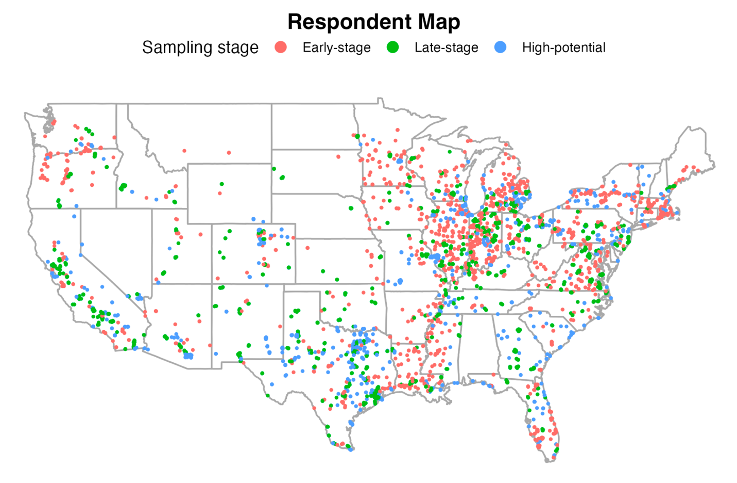
In total, 5,199 respondents accessed the survey from 47 states, a response rate of 4.64%. 3,806 respondents completed the entire survey. Respondents were split evenly across the three “early-stage,” “late-stage,” and “high-potential” communities. Very encouragingly, 85% of respondents agreed to be recontacted for follow-up surveys, enabling us to track opinion change over time in these communities.
Measuring opinions
Support for large-scale solar development
Our core measure of support/opposition to LSS in a local community asks respondents whether they support/oppose “using a large parcel of land in your local community to build a large solar power facility for generating electricity.” Respondents could answer on a 5-point Likert scale (strongly support; somewhat support; neither support nor oppose; somewhat oppose; strongly oppose).
Next, we asked them to think of their neighbors’ opinions on the same question, providing a “second-order” measure of their perceived support/opposition levels. Finally, we asked them to think about the country as a whole, and whether they would support/oppose “greatly increasing the number of solar power facilities for generating electricity using some large parcels of land across the country?”
LSS support in the context of alternative land uses
Given that there are multiple ways an open parcel of land could be developed, we randomly set aside some respondents to be asked about support/opposition to these alternate land uses instead of asking them about LSS. This allows us to make clean comparisons between land uses. In addition to LSS, we measured support/opposition to the following energy-related land uses: wind turbines for generating electricity (10% of the sample), an oil/gas refinery (10% of the sample), and transmission lines (10% of the sample).
The survey included another method for measuring ranked preferences over alternative land uses. We adapted a measurement technique called MaxDiff (or best-worst scaling) frequently used in market research to generate rankings for things like product features, but under-used in political and public affairs research. From a list of eleven possible land uses, respondents were randomly shown a list of five options and asked to choose which one would be, in their opinion, the best use of land and which would be the worst. They completed this choice task three times on different sets of options. We then aggregate across the full sample of respondents to generate ranked preferences and quantify differences in preference intensity.
Measuring how project characteristics can move support
Community support/opposition to a local project can be shaped by the characteristics of a proposed development. Some of these characteristics are inherent to the project itself (such as project size), and others can be included in agreements with the host community regarding how benefits from the project can be enjoyed.
To measure how these characteristics affect community support, we used a gold-standard measurement technique called a conjoint experiment. This technique involves presenting respondents with two projects side-by-side and asking them which one they prefer (in addition, they can rate each project on a 0-10 scale). Each of the two side-by-side projects has a consistent set of categories: project size; compensation; suppliers; labor; who will use the electricity; and managing impact. But within these categories, the projects have randomly varying characteristics. This randomization, once we aggregate the choices made by all the respondents, allows us to isolate and identify the effect of changing a project’s characteristics. For example, we can identify the effect of changing a project’s size (say, going from 250 acres to 500 acres) or electricity allocation (say, households vs. data centers) on respondents’ support for a project.
In technical terms for readers with an econometrics background, the estimand is the Average Marginal Component Effect (AMCE) of varying a particular level of a project attribute (relative to the baseline). We estimate this effect using ordinary least squares regression with robust standard errors clustered at the respondent level, with results reported against pre-registered baseline levels.
Zooming-in on agrivoltaics
Given that so many of these potential LSS developments are in rural communities where agriculture plays an important role in the economy and identity of the community, we wanted to test whether incorporating agrivoltaics into LSS projects can move support. We do that as part of the conjoint experiment described above (in the “managing impact” category of project characteristics); but we also incorporate a randomized experiment into the questionnaire. Half of respondents are asked whether learning that a project would replace farmland would improve or worsen their opinion of a local LSS project. The other half are asked whether agrivoltaics (described to respondents as a project that would be “co-located with farmland, so that farming could occur between or underneath the solar panels”) would improve or worsen their opinion of the project. Because assignment to one of the two conditions was random, we can identify the effect of the agrivoltaics framing on opinion change. In our analysis, we compare opinion change among respondents who are already supportive/opposed/neutral toward LSS development in their community.
For more information
Contact the researchers at:
Gabriel De Roche, Ph.D.